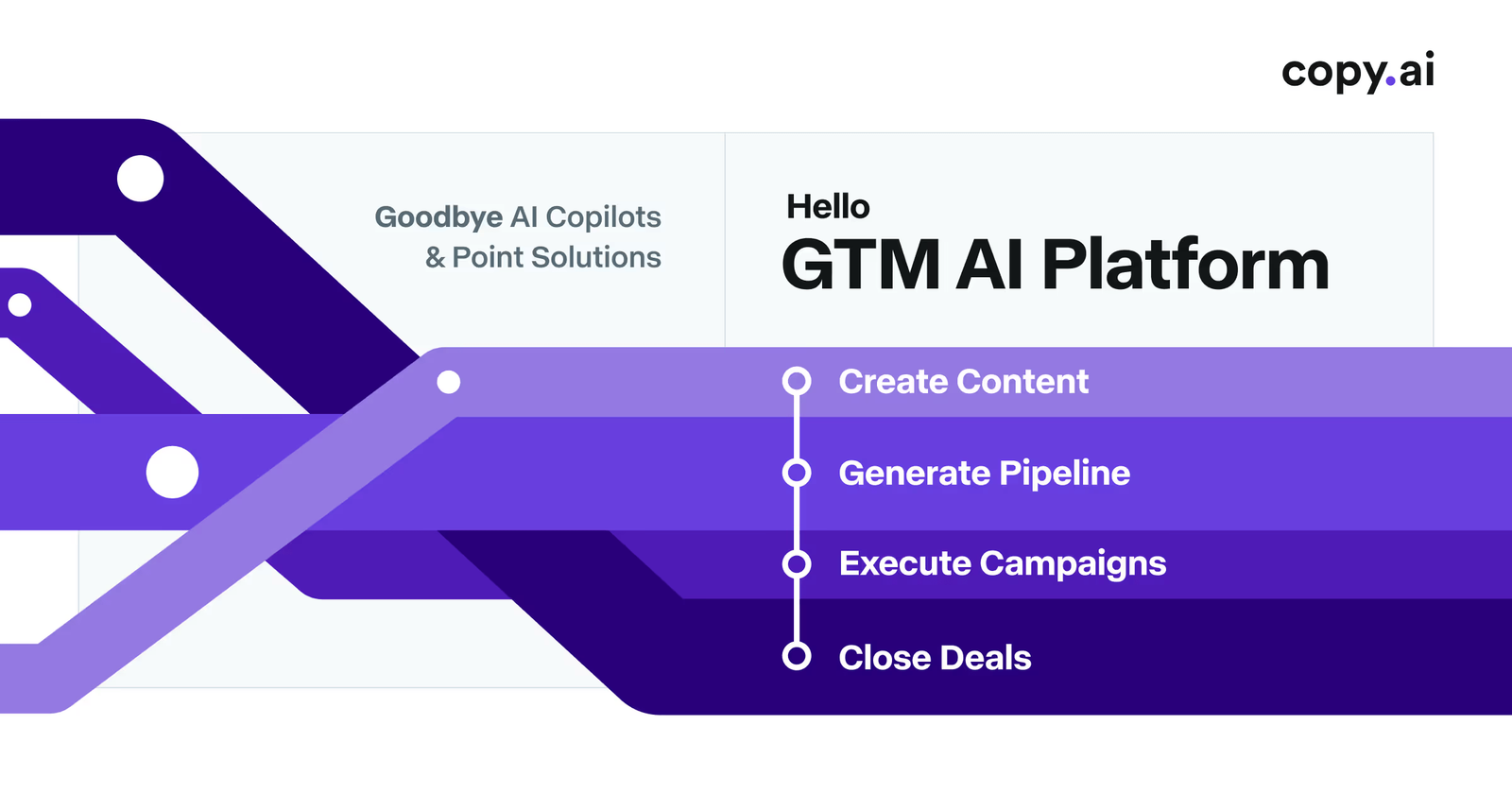
Started as a marketing copy generator, Copy.ai now describes itself on its homepage as "The First AI-Native GTM Platform" and frames its pitch around replacing "dozens of copilots and point solutions" with a single go-to-market system. The Copy.ai homepage also states that the platform is "Trusted by 17 million users at leading companies," a vendor claim rather than an audited figure.
The Copy.ai architecture is published as a set of named components. Workflows are AI-powered codifications of processes, plays, and best practices; Actions are building blocks for users who are not AI experts; Agents automate targeted tasks with guardrails; Tables provide a queryable data foundation that consolidates disparate sources; Chat is the prompting interface for one-off tasks; Infobase is a central repository of company information; and Brand Voice defines the tone applied to generated content. Copy.ai also advertises 2,000+ integrations and describes itself as LLM model agnostic.
The people Copy.ai is built for are content marketers, demand generation managers, sales enablement leads, and revenue operations owners who ship a high volume of briefs, outreach sequences, landing copy, and translated assets every week. Copy.ai groups its published use cases into a prospecting cockpit for account and contact research, a content creation engine for SEO, thought leadership, use cases, and social, inbound lead processing that enriches and engages marketing-generated leads, account based marketing asset production, translation and localization, and deal coaching and forecasting built on sales transcripts.
In daily use, a writer opens Copy.ai Chat to produce a one-off draft using OpenAI, Anthropic, or Gemini models, while an operations owner assembles a Copy.ai Workflow that pulls rows from Tables, layers in Infobase context and the configured Brand Voice, and returns a batch of drafts in one run. Because Copy.ai charges those batch runs against a monthly workflow credit balance, capacity planning inside Copy.ai revolves around credits consumed per recurring play rather than around word counts.
Packaging on the Copy.ai pricing page splits into self-serve and enterprise. The Copy.ai Chat plan covers 5 seats with unlimited words in chat, unlimited chat projects, and access to OpenAI, Anthropic, and Gemini models at $29 per month billed monthly, or $24 per month billed as $288 per year with an advertised 20% saving. Copy.ai Growth is $1,000 per month billed $12,000 per year for 75 seats and 20K workflow credits per month, Copy.ai Expansion is $2,000 per month billed $24,000 per year for 150 seats and 45K credits, and Copy.ai Scale is $3,000 per month billed $36,000 per year for 200 seats and 75K credits. Copy.ai Enterprise is quote-only and adds guided jumpstart implementation, API access, bulk workflow runs, 20+ tech integrations, unlimited customizable workflows, designated account support, and enterprise grade security protocols.
The rough edges around Copy.ai are mostly commercial. Copy.ai leaves a wide gap between the $29 Chat plan and the $1,000 Growth plan, so a small team that outgrows chat has no published middle step. The Copy.ai pricing page lists FAQ headings such as "What is a credit worth?" and "How much does a workflow run cost?" without visible answers in the crawled page text, which pushes credit economics into a sales call. Copy.ai terms of service also describe an annual subscription charged at the beginning of the term with a five-day full-refund window, while the Copy.ai pricing page advertises a monthly billing toggle, and the Copy.ai contact page still promises 2,000 free words per month with no credit card even though the pricing page lists no $0 plan.
Against single-purpose drafting assistants, Copy.ai sells breadth: one account is expected to cover article production, outbound research, and localization through shared workflows instead of separate subscriptions. Against general automation platforms, Copy.ai leans on prebuilt go-to-market plays, brand voice enforcement, and seat-plus-credit packaging aimed at revenue teams rather than at developers wiring their own pipelines.
Buyers evaluating Copy.ai should map two numbers before signing: how many seats each department actually needs against the fixed 5, 75, 150, and 200 seat counts, and how many workflow credits a monthly content or research cadence burns. Copy.ai is straightforward to trial through Chat, but the value case for Copy.ai lands at the Growth tier and above, where workflows, credits, and integrations do the heavy lifting.