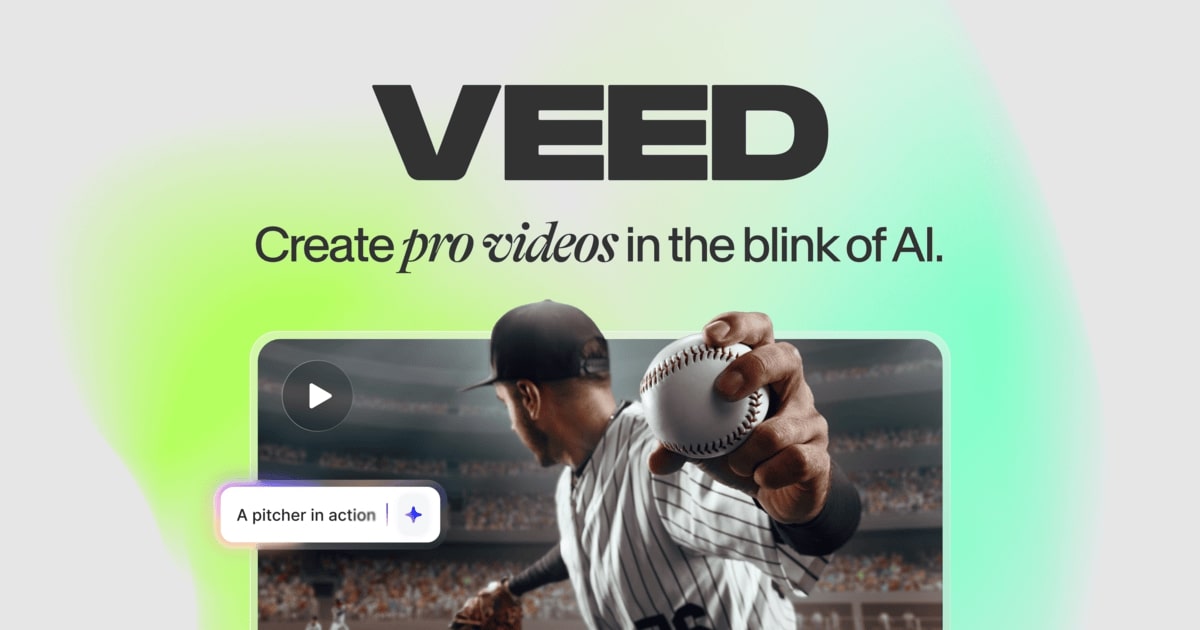
Registered in London and founded in 2018 by Sabba Keynejad and Timur Mamedov, VEED began as a browser utility for trimming clips and burning in captions and has since rebuilt itself around an idea-to-video pipeline where generation and editing share one timeline. The VEED homepage headline reads "Create pro level videos in the blink of AI", and a second section promises to "Generate videos that look like your brand, not AI", which tells you where the product has moved: fewer manual cuts, more prompt output that still carries a company's identity.
The buyer VEED names in its own meta description is marketers and solopreneurs, and the testimonials on the VEED homepage match that profile — a VP of Marketing, an agency founder, a demand generation manager, a senior content producer and a videographer, all talking about social and ad output rather than broadcast post. Growth marketers running user-generated-content ads get an explicit callout, with one quoted customer crediting VEED's Eye Correction and Noise Reduction for advertising returns.
A working session in VEED starts either from a text prompt or from uploaded footage. On the generation side VEED lists an AI Video Generator, Text to Video, Image to Video, AI Avatar, AI Text to Speech, AI Voice Generator, AI Reel Generator and an AI Clip Generator that pulls short cuts out of long recordings. On the editing side VEED keeps the original toolbox: automatic subtitles, dynamic subtitles, a video translator, dubbing, background noise removal for audio and for video, a background remover, a teleprompter, a screen recorder, an MP4 compressor and text overlays.
Model choice is part of the VEED proposition. The tools menu on the VEED site names Fabric 1.0 next to Sora 2, Veo 3.1 and Kling AI, so a user selects a generation engine inside the same editor instead of exporting between apps. Brand kits then reapply one visual identity across whatever those models return, which is the practical reason a marketing team would pick VEED over a bare model playground.
Packaging is freemium in shape. The VEED pricing page opens with "Great videos start with plan" and "Start for free, upgrade to get powerful features", and the structured data VEED publishes on its homepage lists an offer price of 0 USD. Individual paid tier prices did not render in the static crawl of the VEED pricing page, so the exact ladder is not reproduced here, but the questions VEED chose for its own pricing FAQ expose the mechanics: AI credits, credit top-ups, per-user charging, subtitle and translation limits, a refund policy, trials on paid plans and separate arrangements for educational institutions.
The constraints deserve attention before a team commits. Because VEED meters generation with AI credits, sustained prompt-to-video work can drain an allowance and push a buyer into buying more credits, and the VEED FAQ itself acknowledges caps on subtitles and translations. VEED charges per user, so a five-person content pod costs materially more than a single creator, and anyone who wants programmatic access has to go through the VEED contact-sales form, where enterprise plans and API access are handled rather than sold self-serve.
Among peers, VEED sits between generation-first tools and conventional editors. Synthesia and HeyGen concentrate on corporate avatar presenters, Descript builds around transcript editing and podcasts, Kapwing and Clipchamp lean on fast browser trimming, and Canva folds video into a broader design suite. What VEED offers instead is the combination of model-backed generation, caption and dubbing tooling and brand kits inside one browser tab, which suits a social content calendar more than a long-form edit.
A reasonable evaluation path is to sign up for the free VEED plan, run one real campaign asset end to end — prompt, subtitle, dub, brand kit, export — and watch how many AI credits that single asset consumes. That number, multiplied by a month of posting and by seat count, is the honest cost of VEED for a given team, and it is the figure the pricing FAQ implies but does not publish.