What is Seldon?
Most model-serving stories begin in a notebook, but Seldon begins at the moment a trained artifact has to survive real traffic, audits and an on-call rotation.
Seldon turns trained models into Kubernetes resources, wiring Kafka-powered inference pipelines, drift detection, explainability and audit logging into one stack that platform engineers at banks, pharma firms and telecoms run on any cloud or on-premise. Seldon's multi-model serving with LRU memory overcommit hosts more models than GPU
Verified facts from the vendor site · Last verified Aug 22, 2026. Independent Seldon review covering pricing, features, who it is for, and alternatives.
Most model-serving stories begin in a notebook, but Seldon begins at the moment a trained artifact has to survive real traffic, audits and an on-call rotation.
Seldon is enterprise. It starts at $0/month. Paid plans include Open Source (Seldon Core 2, MLServer, Alibi Detect, Alibi Explain): monthly $0/mo: yearly $0/yr ($0/mo effective); LLM Module: Custom quote; MPM Module: Custom quote; Enterprise Platform: Custom quote. Check seldon.io for current prices.
Seldon has a free tier. Paid plans are available for higher limits and team features.
Seldon is best for aI platform engineering leads in regulated enterprises who must serve, monitor and explain production models inside their own Kubernetes clusters instead of a vendor's hosted endpoint..
Seldon is best for aI platform engineering leads in regulated enterprises who must serve, monitor and explain production models inside their own Kubernetes clusters instead of a vendor's hosted endpoint.. Skip it if seldon publishes no pricing page at all, so the LLM Module, MPM Module and Enterprise Platform require a sales briefing before any cost is known.
The main Seldon features are Seldon Core 2 declares models and pipelines as Kubernetes custom resources, Automatic inference server selection, scaling, monitoring and audit logging from one manifest, Composable data-centric pipelines connecting models, processing steps, custom logic and monitors over Kafka, MLServer lightweight multi-framework inference server with REST and gRPC support, and Open Inference Protocol compatibility across model types.
The closest Seldon alternatives on Citeware are Pollinations.AI, Pinokio, Blackbox, Snorkel AI, Toloka. Full list: https://citeware.io/alternatives/seldon.
Limitations called out on this listing: Seldon publishes no pricing page at all, so the LLM Module, MPM Module and Enterprise Platform require a sales briefing before any cost is known; Seldon states on the homepage that modular design lets buyers "budget accurately and only pay for what you need," yet no public plan table supports that claim — a vendor contradiction worth flagging; Seldon's homepage carries two conflicting award claims on one page: "Top Open-Source AI Deployment Tool 2026" and "Ranked #4 best open-source AI deployment tool of 2026"; Seldon leads with "Seldon is now TrueFoundry" while continuing to market Seldon-branded modules and roadmaps, leaving the contracting entity and long-term product naming unclear; Seldon requires an operational Kubernetes cluster, service mesh and Kafka knowledge, so there is no credit-card path to a hosted endpoint; Seldon lists a legacy Seldon Core alongside Seldon Core 2, so existing users face a migration decision; Seldon's testimonials on the homepage are attributed only to "Enterprise Customer" without named sources.
Seldon is available on Kubernetes, Self-hosted / on-premise, AWS, Microsoft Azure, Google Cloud, Alicloud, DigitalOcean, OpenShift, Docker, Linux.
Seldon integrates with Prometheus, Grafana, Kafka, Jaeger, Elasticsearch, Triton Inference Server, MLflow, Weights & Biases, Istio, Envoy, Argo CD, Flux, AWS EKS, Azure AKS, Google GKE, OpenShift, Hugging Face, LangSmith, rclone (40+ storage backends), Open Inference Protocol, Databricks, DigitalOcean.
vs Seldon vs Pollinations.AIBuild AI apps with one API, user wallets, and developer earningsvs
 Seldon vs Pinokio1-click launch any open-source app.vs
 Seldon vs BlackboxEncrypted single-tenant inference plus a 300+ model router behind one endpointvs
 Seldon vs Snorkel AIThe frontier AI data lab building expert training data, benchmarks, and runnable evaluation environmentsvs
 Seldon vs TolokaExpert-curated training, evaluation and red-teaming data for AI agents and LLMsvs
 Seldon vs ZepAgent memory at enterprise scale, built on temporal context graphs
Public threads about Seldon
Community observations
No recent Hacker News threads
Nothing matched Seldon on Hacker News right now. Search X, Reddit, or another network above.
Citeware analysis
Most model-serving stories begin in a notebook, but Seldon begins at the moment a trained artifact has to survive real traffic, audits and an on-call rotation. Seldon Core 2 declares a model as a Kubernetes custom resource, selects an inference server automatically, and folds scaling, monitoring and audit logging into the same manifest. The Seldon homepage demonstrates this with a two-object example: a scikit-learn iris model defined by a storage URI and a memory request, then composed into a pipeline that routes predictions through an outlier detector.
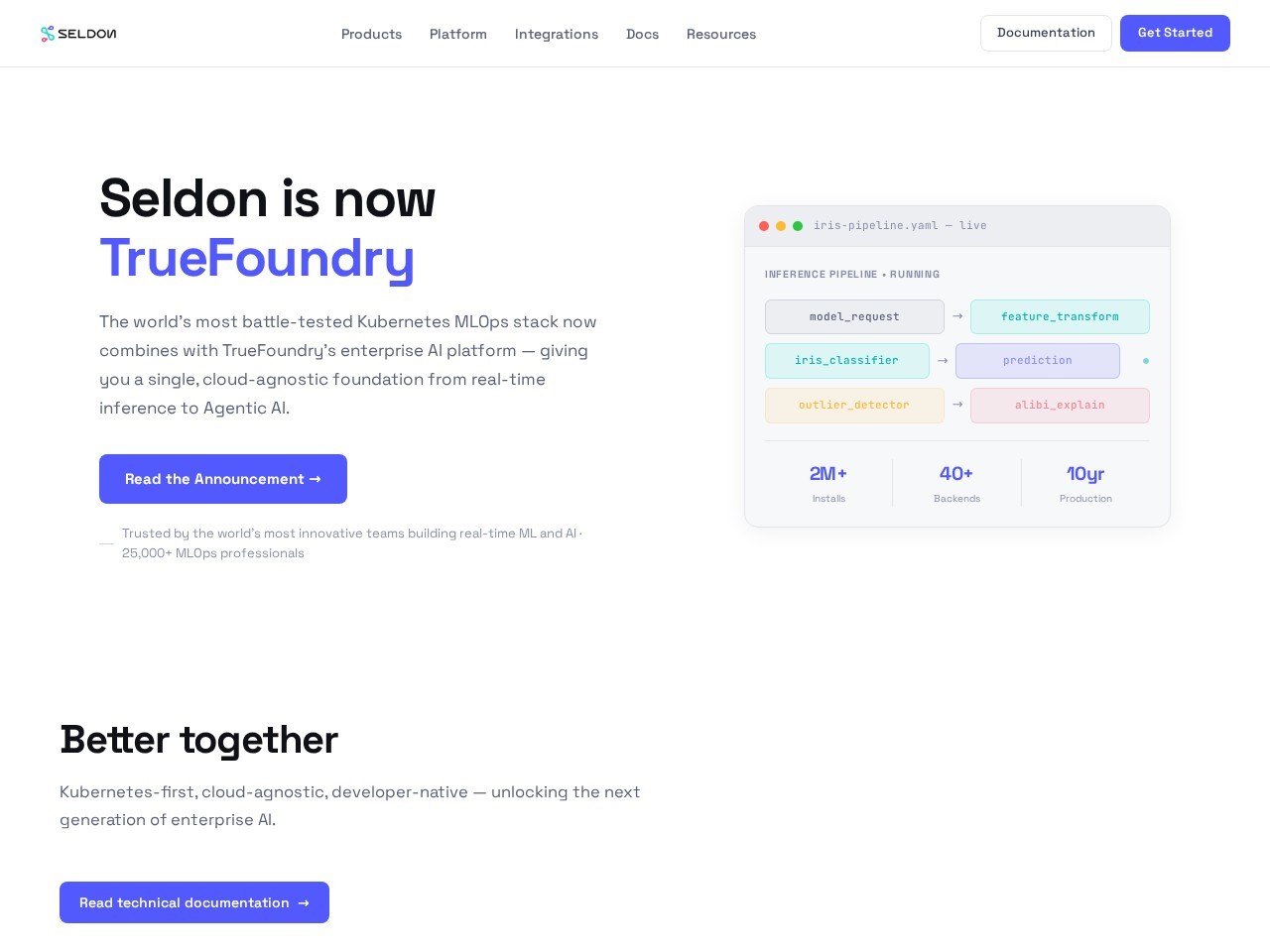
Seldon is written for AI platform engineering groups rather than solo data scientists. The vendor names VP Engineering, Chief AI Officers and AI Platform Architects as the roles Seldon is purpose-built for, and lists Capital One, Covea, AstraZeneca, GSK, Aselsan, Noda and Cambridge University among the organizations using Seldon. Seldon also publishes 2M+ installs, 40+ storage backends, ten years of production usage and 25,000+ MLOps professionals as proof points on the same page.
The Seldon ecosystem is deliberately modular. Seldon Core 2 is the open-source deployment engine, MLServer is a lightweight multi-framework inference server speaking REST, gRPC and the Open Inference Protocol, and Alibi Detect and Alibi Explain supply outlier, adversarial and drift detection alongside local, global, black-box and white-box explanation methods. Layered on top, Seldon sells the LLM Module for generative workflows with prompt orchestration and configurable guardrails, the MPM Module for classification and regression quality metrics, and the Enterprise Platform for authentication, audit trails and team controls.
In daily practice, a team running Seldon commits manifests through Argo CD or Flux, routes traffic with Istio or Envoy, streams pipeline data over Kafka, and reads latency and drift from Prometheus and Grafana dashboards. Seldon supports A/B tests, canary deployments, shadow deployments and multi-armed bandits so a challenger model can be promoted without downtime. Seldon's multi-model serving with LRU memory swapping consolidates several models onto shared inference servers, which the vendor frames as a direct cut to GPU spend.
Pricing for Seldon is not published anywhere on the crawled site. Seldon exposes no pricing page, so only the open-source projects carry a knowable cost of zero, while the LLM Module, MPM Module and Enterprise Platform are quoted through a scheduled platform briefing. Seldon describes its modular architecture as a way to "budget accurately and only pay for what you need," yet no plan table backs that line, so procurement should expect a sales-led quote for anything beyond Core 2, MLServer and Alibi.
Two open questions deserve an early conversation with the Seldon team. The homepage leads with "Seldon is now TrueFoundry," describing a combined Kubernetes-first platform that extends into agentic AI, while the remainder of the same page continues to market Seldon modules, Seldon docs and a Seldon roadmap, leaving contracting entity, support ownership and long-term module naming unresolved. Seldon also states both "Top Open-Source AI Deployment Tool 2026" and "Ranked #4 best open-source AI deployment tool of 2026" on the same page, and those two vendor claims contradict each other.
Compared with category peers, Seldon sits far closer to KServe and Ray Serve than to a hosted model endpoint, because Seldon assumes a cluster the buyer already operates and trades managed convenience for portability across AWS EKS, Azure AKS, Google GKE, Alicloud, DigitalOcean and OpenShift. Teams that want a credit-card API and a token meter will find Seldon heavier than they need; teams that must keep inference inside their own VPC, log every prediction and explain every decision to a regulator will find that weight is the point.
The practical entry path into Seldon is the open-source route: install Seldon Core 2 on an existing cluster, serve a model through MLServer, add Alibi Detect for drift, and only then evaluate whether the LLM Module, MPM Module or Enterprise Platform justify a commercial conversation. Documentation for every Seldon component lives at docs.seldon.ai, spanning quickstart guides through advanced production patterns, and the legacy Seldon Core remains documented separately for teams still running the original engine.
Suitable for
AI platform engineering leads in regulated enterprises who must serve, monitor and explain production models inside their own Kubernetes clusters instead of a vendor's hosted endpoint.
Evidence: Homepage (Primary) · Verified Aug 22, 2026.
Citeware analysis
Evidence: Homepage (Primary) · Verified Aug 22, 2026.
Verified facts
Evidence: Homepage (Primary) · Verified Aug 22, 2026.
Verified facts
Open Source (Seldon Core 2, MLServer, Alibi Detect, Alibi Explain)
$0/mo
LLM Module
Custom quote
MPM Module
Custom quote
Enterprise Platform
Custom quote
Evidence: Homepage (Primary) · Verified Aug 22, 2026.
Verified facts
The company behind Seldon is Seldon Technologies Ltd.
Registration: 09188032
Citeware analysis
Named models, written separately. These are labeled Citeware analysis, not vendor claims.
anthropic · claude-opus-5 · Aug 22, 2026
Seldon remains one of the most credible Kubernetes-native serving stacks for regulated ML, with genuinely useful open-source pieces in Core 2, MLServer and Alibi. The TrueFoundry absorption and the total absence of published pricing make the commercial side far harder to judge than the technology.
As of August 2026 the engineering still looks strong, but the TrueFoundry merge and silent pricing mean buyers should contract carefully and pin down product naming.
The open-source core is the real argument here. Declaring models and pipelines as Kubernetes custom resources, routing experiments as first-class primitives, and Alibi's drift and explanation methods give platform teams something to evaluate for the cost of cluster time.
Multi-model serving with LRU overcommit is a legitimate GPU cost lever, not a marketing line.
Strengths
Watch-outs
openai · gpt-5.6-terra · Aug 22, 2026
Seldon is a strong fit for Kubernetes-mature enterprises that need inference control, evidence trails, and flexible rollout patterns. Its technical breadth is compelling, but opaque commercial terms and the TrueFoundry transition deserve diligence before a strategic commitment.
As of August 2026, Seldon remains a credible open-source production stack, though its TrueFoundry branding and undisclosed module pricing muddy the buying decision.
The factual case is solid: Core 2, MLServer and Alibi provide a capable open-source base for serving, monitoring, drift detection and explanations on Kubernetes. Its routing options and multi-model overcommit are unusually practical for platforms operating many live models.
Strengths
Watch-outs
Verified facts
Common questions about Seldon.
Most model-serving stories begin in a notebook, but Seldon begins at the moment a trained artifact has to survive real traffic, audits and an on-call rotation. Source: https://seldon.io/
Seldon is enterprise. It starts at $0/month. Paid plans include Open Source (Seldon Core 2, MLServer, Alibi Detect, Alibi Explain): monthly $0/mo: yearly $0/yr ($0/mo effective); LLM Module: Custom quote; MPM Module: Custom quote; Enterprise Platform: Custom quote. Check seldon.io for current prices. Source: https://seldon.io/
Seldon has a free tier. Paid plans are available for higher limits and team features. Source: https://seldon.io/
Seldon is best for aI platform engineering leads in regulated enterprises who must serve, monitor and explain production models inside their own Kubernetes clusters instead of a vendor's hosted endpoint.. Source: https://seldon.io/
Seldon is best for aI platform engineering leads in regulated enterprises who must serve, monitor and explain production models inside their own Kubernetes clusters instead of a vendor's hosted endpoint.. Skip it if seldon publishes no pricing page at all, so the LLM Module, MPM Module and Enterprise Platform require a sales briefing before any cost is known. Source: https://seldon.io/
The main Seldon features are Seldon Core 2 declares models and pipelines as Kubernetes custom resources, Automatic inference server selection, scaling, monitoring and audit logging from one manifest, Composable data-centric pipelines connecting models, processing steps, custom logic and monitors over Kafka, MLServer lightweight multi-framework inference server with REST and gRPC support, and Open Inference Protocol compatibility across model types. Source: https://seldon.io/
The closest Seldon alternatives on Citeware are Pollinations.AI, Pinokio, Blackbox, Snorkel AI, Toloka. Full list: https://citeware.io/alternatives/seldon. Source: https://seldon.io/
Limitations called out on this listing: Seldon publishes no pricing page at all, so the LLM Module, MPM Module and Enterprise Platform require a sales briefing before any cost is known; Seldon states on the homepage that modular design lets buyers "budget accurately and only pay for what you need," yet no public plan table supports that claim — a vendor contradiction worth flagging; Seldon's homepage carries two conflicting award claims on one page: "Top Open-Source AI Deployment Tool 2026" and "Ranked #4 best open-source AI deployment tool of 2026"; Seldon leads with "Seldon is now TrueFoundry" while continuing to market Seldon-branded modules and roadmaps, leaving the contracting entity and long-term product naming unclear; Seldon requires an operational Kubernetes cluster, service mesh and Kafka knowledge, so there is no credit-card path to a hosted endpoint; Seldon lists a legacy Seldon Core alongside Seldon Core 2, so existing users face a migration decision; Seldon's testimonials on the homepage are attributed only to "Enterprise Customer" without named sources. Source: https://seldon.io/
Seldon is available on Kubernetes, Self-hosted / on-premise, AWS, Microsoft Azure, Google Cloud, Alicloud, DigitalOcean, OpenShift, Docker, Linux. Source: https://seldon.io/
Seldon integrates with Prometheus, Grafana, Kafka, Jaeger, Elasticsearch, Triton Inference Server, MLflow, Weights & Biases, Istio, Envoy, Argo CD, Flux, AWS EKS, Azure AKS, Google GKE, OpenShift, Hugging Face, LangSmith, rclone (40+ storage backends), Open Inference Protocol, Databricks, DigitalOcean. Source: https://seldon.io/
Common Seldon use cases include Serving real-time ML inference inside a regulated bank's own Kubernetes cluster, Running drift and outlier detection alongside live predictions in pharmaceutical model pipelines, Promoting a challenger model through canary or shadow deployment without downtime, Consolidating many small models onto shared inference servers to reduce GPU spend, Adding explainability to every prediction for audit and compliance review, Deploying generative AI workflows with prompt orchestration and guardrails on existing Kubernetes infrastructure, Standardizing model handoff between data science teams and platform engineering, Keeping inference and data on-premise where cloud egress is not permitted. Source: https://seldon.io/
Seldon is made by Seldon Technologies Ltd, founded in 2014. Registration number 09188032. Official site: https://seldon.io/.
Seldon runs on Kubernetes and the vendor states it is tested on AWS EKS, Azure AKS, Google GKE, Alicloud, DigitalOcean and OpenShift, as well as on-premise. Seldon positions this portability as avoiding vendor lock-in, with data staying wherever the organization requires. Source: https://seldon.io/
The Seldon homepage announces "Seldon is now TrueFoundry" and describes a combined Kubernetes-first platform extending into agentic AI, while the same page still markets Seldon Core 2, MLServer, Alibi and the Enterprise Platform. Existing Seldon customers are pointed to a briefing covering the combined roadmap, so contracting and support ownership should be confirmed directly. Source: https://seldon.io/
Getting started with Seldon means installing Seldon Core 2 on an existing cluster and applying a manifest that declares a model with a storage URI and memory request, then composing it into a pipeline. Documentation for every Seldon component, from quickstart to advanced production patterns, is hosted at docs.seldon.ai. Source: https://seldon.io/
Yes. Seldon offers an LLM Module for deploying generative AI workflows with prompt orchestration, observability, production-ready scaling and built-in configurable guardrails, and Seldon Core 2 is described as an MLOps and LLMOps framework rather than a classical-ML-only engine. Source: https://seldon.io/
Evidence: Homepage (Primary) · Verified Aug 22, 2026.
Looking for more options? Browse all Seldon alternatives.
Public threads about Seldon
Community observations
No recent Hacker News threads
Nothing matched Seldon on Hacker News right now. Search X, Reddit, or another network above.