What is Zep?
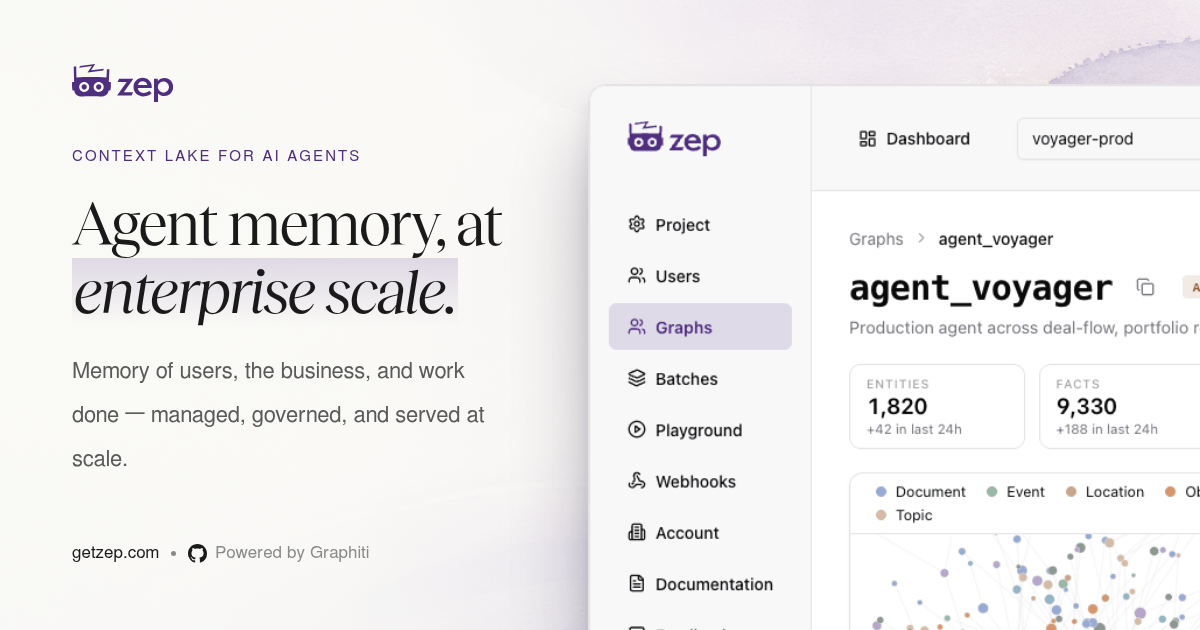
Zep Software, Inc. describes Zep as a "Context Lake" — the data-lake pattern applied to agent context, where millions of individual context graphs are governed and served as one system.
Zep stores agent memory in temporal context graphs built from chat history, business data and user interactions, invalidating superseded facts and returning assembled context with p95 retrieval under 200ms. Engineering teams shipping production agents call Zep from Python, TypeScript and Go SDKs, with SOC 2 Type II and BYOC deployment.
1 / 2
Verified facts from the vendor site · Last verified Aug 22, 2026. Independent Zep review covering pricing, features, who it is for, and alternatives.
Zep Software, Inc. describes Zep as a "Context Lake" — the data-lake pattern applied to agent context, where millions of individual context graphs are governed and served as one system.
Zep is freemium. It starts at $0/month. Paid plans include Free: monthly $0/mo: yearly $0/yr ($0/mo effective); Flex: monthly $125/mo: yearly $1250/yr ($104.17/mo effective, save 17%); Flex Plus: monthly $375/mo: yearly $3750/yr ($312.5/mo effective, save 17%). Check getzep.com for current prices.
Zep has a free tier. Paid plans start at $125/month.
Zep is best for teams giving a production customer-support agent persistent memory of a user's prior issues and stated preferences and fusing CRM, billing and product-event JSON into a single per-user graph an agent can query.
Zep is best for teams giving a production customer-support agent persistent memory of a user's prior issues and stated preferences and fusing CRM, billing and product-event JSON into a single per-user graph an agent can query. Skip it if zep plan limits come from the published pricing table..
The main Zep features are Temporal context graphs that record facts with a validity window, Fact invalidation when new information contradicts the graph, with old facts kept as history, Point-in-time queries: ask what is true now or what was true on a past date, Multi-source ingest from chat history, business data (JSON) and user interactions, and Automated context assembly returning token-efficient context blocks.
The closest Zep alternatives on Citeware are Pollinations.AI, Pinokio, Blackbox, Seldon, Snorkel AI. Full list: https://citeware.io/alternatives/zep.
Limitations called out on this listing: Zep plan limits come from the published pricing table.; Zep packaging is recorded from the vendor pages available at analysis time..
Zep is available on Web.
 vs
vs Zep vs Pollinations.AIBuild AI apps with one API, user wallets, and developer earningsvs
 Zep vs Pinokio1-click launch any open-source app.vs
 Zep vs BlackboxEncrypted single-tenant inference plus a 300+ model router behind one endpointvs
 Zep vs SeldonKubernetes-native MLOps and LLMOps serving, from open-source inference to enterprise governancevs
 Zep vs Snorkel AIThe frontier AI data lab building expert training data, benchmarks, and runnable evaluation environmentsvs
 Zep vs TolokaExpert-curated training, evaluation and red-teaming data for AI agents and LLMs
Public threads about Zep
Community observations
No recent Hacker News threads
Nothing matched Zep on Hacker News right now. Search X, Reddit, or another network above.
Citeware analysis
Zep Software, Inc. describes Zep as a "Context Lake" — the data-lake pattern applied to agent context, where millions of individual context graphs are governed and served as one system. Rather than replaying a growing transcript into every model call, Zep ingests each Episode (a chat message, a JSON payload, or a block of text), extracts entities and facts into a graph, and hands back a compact context block on request. The Zep homepage publishes p95 retrieval latency of 148ms at 10K graphs rising only to 168ms at 100M, and states that retrieval with Zep "stays under 200 milliseconds, regardless of graph size or count."
Temporality is the organising idea in Zep. When incoming information contradicts an existing fact, Zep invalidates the old fact instead of deleting it, so an application can ask Zep both what is true now and what was true on a given past date. Zep also surfaces what the company calls Observations — patterns, recurrences and co-occurrences detected in the shape of the graph, such as a customer who upgrades within two weeks of each product launch. Every fact inside a Zep graph traces back to the source episode that produced it, which is what makes an answer auditable rather than merely plausible.
Day-to-day work with Zep is deliberately small in surface area: add messages to a thread with return_context enabled, push structured business data into a user's graph with graph.add, and pull assembled context with get_user_context. Zep ships SDKs for Python, TypeScript and Go, and the vendor states Zep works with any agent framework or none at all. Around those calls, Zep adds a Memory MCP Server with seats metered per plan, webhooks, analytics, and a dashboard reporting episodes added, graphs and users created, average latency and error rate.
Zep bills on credits rather than seats or stored bytes. One credit covers an Episode up to 350 bytes, with one further credit for each additional 350 bytes or part thereof, while webhook invocations cost 1/8 credit where available and retrieval, storage, threads, users and graph storage are billed at zero credits. The self-serve Flex plan on the Zep pricing page is $1,250 per year, shown as $104 per month billed annually and as $125 per month on the plan comparison table, and includes 50,000 credits a month with overage at $25 per 10,000 credits. Flex Plus is $3,750 per year, shown as $312 per month billed annually and $375 per month on the comparison table, with 200,000 credits a month and $75 per 40,000 credits of overage.
Enterprise pricing at Zep is quoted rather than published: custom credit volumes at negotiated rates, guaranteed rate limits with an SLA, unlimited projects, custom Memory MCP Server seats, one-year API log retention, and Slack or Teams support with a dedicated account manager. Zep additionally advertises an "emerging price" for fast-growing venture-capital funded startups. Deployment scales alongside the plan — managed Zep Cloud on every tier, Cloud plus customer-held KMS keys on AWS, GCP or Azure as BYOK, and Bring Your Own Cloud where the Zep service runs inside the customer's own VPC.
The constraints in Zep deserve a close read before commitment. Zep credits roll over for 30 days on Flex and 60 days on Flex Plus, while free-plan credits do not roll over at all; the Zep FAQ also warns that Free and Flex accounts may see rate limits lowered depending on service-wide load, with lower-priority Episode processing on the free tier. Observations, webhooks, analytics and custom extraction instructions are withheld from Flex and appear only from Flex Plus upward, and Flex retains API logs for a single day against seven days on Flex Plus.
Buyers should also note a documented inconsistency on the Zep pricing page itself: the plan comparison table places SOC 2 Type II, HIPAA BAA, audit logs and the EU DPA in the Enterprise column with dashes against Flex and Flex Plus, while the Zep FAQ directly below answers that Zep is SOC 2 Type II certified and that Zep signs Data Processing Agreements with EU customers. Both statements come from Zep and both are recorded here; a compliance reviewer on a self-serve plan should get the applicable scope in writing.
Against peers in agent memory and retrieval infrastructure, Zep leans on structure and governance rather than on being the cheapest key-value memory store. Zep is built on the open-source Graphiti framework and a proprietary Context Graph Engine, publishes LoCoMo (94.7% accuracy, 155ms retrieval, 5,760 tokens) and LongMemEval (90.2% accuracy, 162ms retrieval, 4,408 tokens) benchmark figures, and maintains a dedicated mem0-alternative page. Teams that only need a scratchpad between turns will find Zep heavier than necessary; teams that must explain where an agent's belief came from, and when it changed, are the audience Zep is written for.
Suitable for
Teams giving a production customer-support agent persistent memory of a user's prior issues and stated preferences and fusing CRM, billing and product-event JSON into a single per-user graph an agent can query
Evidence: Homepage (Primary) · Pricing (Primary) · About (Primary) · Verified Aug 22, 2026.
Citeware analysis
Evidence: Homepage (Primary) · Verified Aug 22, 2026.
Verified facts
Evidence: Homepage (Primary) · Verified Aug 22, 2026.
Verified facts
Free
$0/mo
Flex
$125/mo
Billed monthly
Flex Plus
$375/mo
Billed monthly
Evidence: Homepage (Primary) · Pricing (Primary) · Verified Aug 22, 2026.
Verified facts
The company behind Zep is Zep AI, Inc.
Operates a cloud-based long-term memory and context-engineering software platform for AI agents and assistants (the "Platform"). Zep Service includes APIs, software development kits, and a web-based dashboard, provisioned with API Key(s) for programmatic access. Enterprise Fees are non-refundable except as expressly set out in the Agreement or an Order Form, and are not eligible for set off. Zep also lists other losses and interruptions it does not cover.
Zep says it collects account and identity, contact details, product usage and analytics, device and ip data, and cookies and tracking. That data is used for registering with the Service by entering email address, user name and password.
No dedicated refund page was found. The Terms of Service state that for Enterprise tier subscriptions all Fees are non-refundable, except as expressly set out in the Agreement or an applicable Order Form, and are not eligible for set off. Self-serve subscription Fees are prepaid at the start of each billing period; no refund entitlement is stated.
Operates a cloud-based long-term memory and context-engineering software platform for AI agents and assistants (the "Platform"). Zep Service includes APIs, software development kits, and a web-based dashboard, provisioned with API Key(s) for programmatic access. Enterprise Fees are non-refundable except as expressly set out in the Agreement or an Order Form, and are not eligible for set off. Zep also lists other losses and interruptions it does not cover.
Zep says it collects account and identity, contact details, product usage and analytics, device and ip data, and cookies and tracking. That data is used for registering with the Service by entering email address, user name and password.
Account and identity
Collectingregistering with the Service by entering email address, user name and password
Contact details
Collectinghelp us communicate with you, respond to questions, technical support, promotional offers
Payment information
Unclearnot addressed in the policy
Product usage and analytics
Collectingimprove the Service, customize the user experience and analyze use patterns
Device and IP data
Collectingimprove the quality of the Service (browser type, device, time and date of access)
User content and uploads
Unclearpreferences you submit are collected as Non-Personal Information
Cookies and tracking
Collectingcollect Non-Personal Information and keep record of the user's preferences
Location
Uncleargeneral demographic information may be collected as Non-Personal Information
Shared with third parties
Collectingshared with vendors performing services for the Company and to meet legal process or protect rights
Advertising and remarketing
UnclearNon-Personal Information may be disclosed to partners, advertisers and other third parties
Used to train AI models
Unclearnot addressed in the policy
How long data is kept
Unclearpersistent cookies remain until deleted; data from children under 13 deleted as soon as possible
Offers a refund: No
No dedicated refund page was found. The Terms of Service state that for Enterprise tier subscriptions all Fees are non-refundable, except as expressly set out in the Agreement or an applicable Order Form, and are not eligible for set off. Self-serve subscription Fees are prepaid at the start of each billing period; no refund entitlement is stated.
Evidence: Terms (Primary) · Privacy (Primary) · Verified Aug 22, 2026.
Citeware analysis
Named models, written separately. These are labeled Citeware analysis, not vendor claims.
anthropic · claude-opus-5 · Aug 22, 2026
Zep is the most serious attempt yet at agent memory as infrastructure — temporal facts with validity windows, provenance back to the source episode, and published latency numbers instead of vague speed claims. The catch is that nearly every governance feature it markets is gated behind Enterprise.
As of August 2026, Zep's temporal fact invalidation is the differentiator worth paying for. The compliance story it leads with, though, only arrives on Enterprise.
The core idea is narrower and better than the marketing suggests. Most memory layers append and hope retrieval sorts it out.
Zep expires facts when new evidence contradicts them, keeps the old ones as history, and traces each one back to the episode that produced it. That lets an agent answer what a customer's plan was last March, and lets you audit why it said something.
Rebuilding that on top of a vector store is a multi-quarter project.
Strengths
Watch-outs
openai · gpt-5.6-terra · Aug 22, 2026
Zep is a compelling enterprise memory layer for agents whose answers depend on changing customer and business facts, not merely chat recall. Its governance and temporal model are unusually well matched to production, though the ingestion-credit model deserves careful capacity planning.
As of August 2026, Zep stands out where agent memory must be temporal, governed, and auditable rather than a thin wrapper around transcript retrieval.
Fact: Zep models facts with validity windows, preserves superseded history, and can return time-specific context with source provenance. That is materially more useful than generic “memory” for support or operations agents that must explain what they knew and when.
Its published p95 retrieval figures remain under 200ms through 100M graphs, although those are vendor-reported results.
Strengths
Watch-outs
Verified facts
Common questions about Zep.
Zep Software, Inc. describes Zep as a "Context Lake" — the data-lake pattern applied to agent context, where millions of individual context graphs are governed and served as one system. Source: https://www.getzep.com/
Zep is freemium. It starts at $0/month. Paid plans include Free: monthly $0/mo: yearly $0/yr ($0/mo effective); Flex: monthly $125/mo: yearly $1250/yr ($104.17/mo effective, save 17%); Flex Plus: monthly $375/mo: yearly $3750/yr ($312.5/mo effective, save 17%). Check getzep.com for current prices. Source: https://www.getzep.com/pricing
Zep has a free tier. Paid plans start at $125/month. Source: https://www.getzep.com/pricing
Zep is best for teams giving a production customer-support agent persistent memory of a user's prior issues and stated preferences and fusing CRM, billing and product-event JSON into a single per-user graph an agent can query. Source: https://www.getzep.com/
Zep is best for teams giving a production customer-support agent persistent memory of a user's prior issues and stated preferences and fusing CRM, billing and product-event JSON into a single per-user graph an agent can query. Skip it if zep plan limits come from the published pricing table.. Source: https://www.getzep.com/
The main Zep features are Temporal context graphs that record facts with a validity window, Fact invalidation when new information contradicts the graph, with old facts kept as history, Point-in-time queries: ask what is true now or what was true on a past date, Multi-source ingest from chat history, business data (JSON) and user interactions, and Automated context assembly returning token-efficient context blocks. Source: https://www.getzep.com/
The closest Zep alternatives on Citeware are Pollinations.AI, Pinokio, Blackbox, Seldon, Snorkel AI. Full list: https://citeware.io/alternatives/zep. Source: https://www.getzep.com/
Limitations called out on this listing: Zep plan limits come from the published pricing table.; Zep packaging is recorded from the vendor pages available at analysis time.. Source: https://www.getzep.com/
Zep is available on Web. Source: https://www.getzep.com/
Common Zep use cases include Giving a production customer-support agent persistent memory of a user's prior issues and stated preferences, Fusing CRM, billing and product-event JSON into a single per-user graph an agent can query, Answering point-in-time questions such as what a customer's plan or preference was on a specific date, Reducing prompt token spend by replacing full chat transcripts with an assembled context block, Auditing why an agent said something by tracing the underlying fact back to its source episode, Detecting behavioural patterns, such as repeat upgrade timing, and feeding them to an agent as Observations, Running agent memory inside a regulated customer's own VPC via Bring Your Own Cloud, Exposing agent memory to IDEs and assistants through the Memory MCP Server. Source: https://www.getzep.com/
Zep is made by Zep AI, Inc, founded in 2023. Official site: https://www.getzep.com/. Source: https://www.getzep.com/about
Zep collects account and identity. registering with the Service by entering email address, user name and password. Zep collects contact details. help us communicate with you, respond to questions, technical support, promotional offers. Zep does not clearly say whether it collects payment information. not addressed in the policy. Zep collects product usage and analytics. improve the Service, customize the user experience and analyze use patterns. Zep collects device and ip data. improve the quality of the Service (browser type, device, time and date of access). Zep does not clearly say whether it collects user content and uploads. preferences you submit are collected as Non-Personal Information. Zep collects cookies and tracking. collect Non-Personal Information and keep record of the user's preferences. Zep does not clearly say whether it collects location. general demographic information may be collected as Non-Personal Information. Zep collects shared with third parties. shared with vendors performing services for the Company and to meet legal process or protect rights. Zep does not clearly say whether it collects advertising and remarketing. Non-Personal Information may be disclosed to partners, advertisers and other third parties. Zep does not clearly say whether it collects used to train ai models. not addressed in the policy. Zep does not clearly say whether it collects how long data is kept. persistent cookies remain until deleted; data from children under 13 deleted as soon as possible. Source: https://www.getzep.com/legal/privacy
Confirm pricing, limits, and support on the official site before you buy. Source: https://www.getzep.com/
Evidence: Homepage (Primary) · Verified Aug 22, 2026.
Looking for more options? Browse all Zep alternatives.
Public threads about Zep
Community observations