What is Reflex?
Two products ship under the Reflex name and are sold together: an Apache 2.0 open-source Python framework installed with pip install reflex, and a hosted platform made up of the Reflex AI Builder and Reflex Cloud.

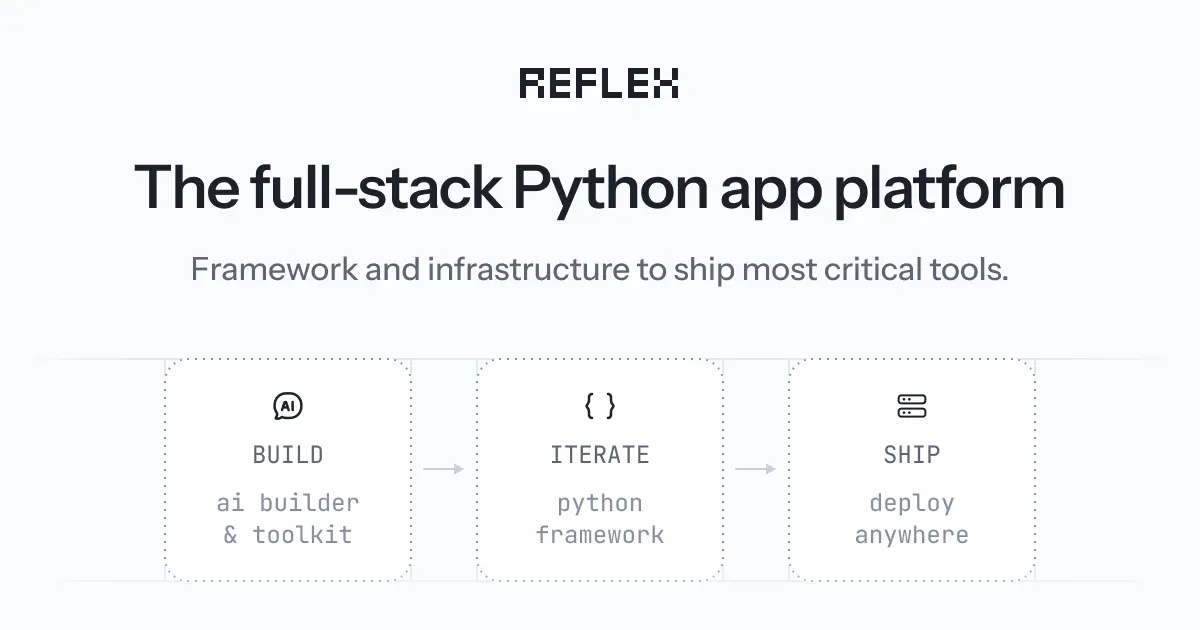
Reflex turns a prompt into a full-stack Python web app, then lets engineers keep iterating in real Reflex code, run pytest and browser tests, and deploy to Reflex Cloud or their own AWS, GCP, Azure, or Databricks account. Python-first internal-tool teams pick Reflex to keep one codebase instead of a split React and API stack.
1 / 2
Verified facts from the vendor site · Last verified Aug 22, 2026. Independent Reflex review covering pricing, features, who it is for, and alternatives.
Two products ship under the Reflex name and are sold together: an Apache 2.0 open-source Python framework installed with pip install reflex, and a hosted platform made up of the Reflex AI Builder and Reflex Cloud.
Reflex is freemium. It starts at $0/month. Paid plans include Free: monthly $0/mo: yearly $0/yr ($0/mo effective); Pro: monthly $25/mo: $25; Enterprise: monthly Custom/mo: Custom. Check reflex.dev for current prices.
Reflex has a free tier. Paid plans start at $25/month.
Reflex is best for teams turning a Python data or ML script into a shareable internal web app and building operational dashboards and admin panels without a separate front-end codebase.
Reflex is best for teams turning a Python data or ML script into a shareable internal web app and building operational dashboards and admin panels without a separate front-end codebase. Skip it if reflex caps the workspace at a single builder on both Free and Pro; team workspaces and viewer seats require an Enterprise contract.
The main Reflex features are Reflex open-source Python framework under the Apache 2.0 license, installed with pip install reflex, Reflex AI Builder that generates and iterates on production Reflex apps conversationally, Direct code editing of generated Reflex projects with live preview, Prompt, file upload, screenshot, and certified template as starting points, and AI-assisted testing that generates and runs pytest, browser, and UI tests.
The closest Reflex alternatives on Citeware are Sourcegraph, Locofy.ai. Full list: https://citeware.io/alternatives/reflex.
Limitations called out on this listing: Reflex caps the workspace at a single builder on both Free and Pro; team workspaces and viewer seats require an Enterprise contract; Reflex limits Free repo sync to public repositories, so private GitHub, GitLab, or Bitbucket sync starts at Pro; Reflex shows one $25 per month Pro sticker beside a 5x / 10x / 20x / 40x usage selector without publishing the price of the higher multiples; The Reflex pricing FAQ lists the question "What happens when I hit my limits?" without a visible answer on the crawled page, so overage behaviour is undisclosed; Reflex restricts deployment to AWS, GCP, Azure, Databricks, and air-gapped self-hosting to Enterprise, so Pro buyers are tied to Reflex Cloud; Reflex marks the security scanner, performance scanner, and Auto-MCP as beta features; Reflex Free retains app metrics logs for only 7 days and allows one hosted app; The Reflex homepage claim of "Powering production apps at 30% of the Fortune 500" is published without supporting methodology.
Reflex is available on Web.
Public threads about Reflex
Community observations
No recent Hacker News threads
Nothing matched Reflex on Hacker News right now. Search X, Reddit, or another network above.
Citeware analysis
Two products ship under the Reflex name and are sold together: an Apache 2.0 open-source Python framework installed with pip install reflex, and a hosted platform made up of the Reflex AI Builder and Reflex Cloud. Inside the Reflex framework a developer declares UI components, state classes, event handlers, database models, and backend logic in one Python codebase, and the Reflex compiler produces the React front end and the API layer underneath.
The buyer Reflex aims at is a Python-first group — data scientists, ML engineers, platform engineers, and internal-tools developers — that already owns the business logic in Python and does not want to staff a separate front-end role to ship a usable interface. Reflex also courts enterprise groups whose finished app must live in a company-controlled cloud account, which is why the Reflex plan table places AWS, GCP, Azure, Databricks, and air-gapped self-hosting behind the Enterprise tier rather than the self-serve plans.
A working session with Reflex usually starts in the Reflex AI Builder, where a prompt, an uploaded file, a screenshot, or a certified template becomes a running project with a live preview. From there Reflex supports direct edits to the generated code, integrations for APIs, databases, auth, and AI providers, generation of pytest, browser, and UI tests alongside the app, and repo sync with GitHub, GitLab, or Bitbucket. Developers who prefer their own editor can point Claude Code, Cursor, or another MCP-aware agent at the Reflex MCP endpoint at mcp.reflex.dev so the agent writes against current Reflex docs and component signatures.
Deployment closes the Reflex loop. A single reflex deploy command, or the deploy action inside the Reflex AI Builder, publishes to Reflex Cloud with app metrics, log retention, multi-region placement, custom domains, and one-click rollbacks on paid plans. Reflex lists SOC-controlled platform operation on every plan, audit logs on Pro and Enterprise, and SSO/SAML, RBAC, and a HIPAA BAA on Enterprise agreements only.
Packaging looks simple on the Reflex pricing page and gets fuzzier on close reading. Free costs $0 and covers the open-source framework, shared AI Builder usage, a single-user workspace, one hosted app on shared compute, AI-assisted testing, MCP Skills, and Discord and GitHub support, with repo sync restricted to public repositories. Pro is listed at $25 per month next to a 5x / 10x / 20x / 40x selector for AI usage relative to the Free allowance, and adds ten hosted apps, custom domains, private projects, app code download, 90-day log retention, one-click rollbacks, audit logs, and the beta security and performance scanners. Enterprise pricing on Reflex is quoted through a demo and covers team workspaces, viewer seats, custom app limits, dedicated compute, the Reflex Enterprise Package, Auto-MCP, and forward-deployed engineer onboarding.
The sharpest limits in Reflex are structural rather than technical. Free and Pro both cap the workspace at one builder, so a second engineer who needs to build in the same workspace pushes the conversation to an Enterprise quote. The Reflex pricing page shows one $25 sticker beside a four-way usage multiplier without publishing what the 10x, 20x, and 40x variants cost, and the FAQ heading "What happens when I hit my limits?" is present without a visible answer on the crawled page, so overage behaviour is not disclosed publicly.
Against peers, Reflex sits between prompt-to-app builders such as Lovable, v0, and Bolt and Python UI frameworks such as Streamlit, Gradio, and Dash. Reflex differs from the JavaScript-output builders by emitting a Reflex Python project the buyer can download, version, and run locally, and differs from Streamlit-style tools by including routing, state classes, database models, and a managed deployment path. Reflex describes itself on the about page as "the operating system on which enterprises build mission-critical applications," and the Reflex homepage claims the platform is "Powering production apps at 30% of the Fortune 500" — vendor statements published without supporting methodology.
Suitable for
Teams turning a Python data or ML script into a shareable internal web app and building operational dashboards and admin panels without a separate front-end codebase
Evidence: Homepage (Primary) · Pricing (Primary) · About (Primary) · Verified Aug 22, 2026.
Citeware analysis
Evidence: Homepage (Primary) · Verified Aug 22, 2026.
Verified facts
Evidence: Homepage (Primary) · Verified Aug 22, 2026.
Verified facts
Free
$0/mo
Pro
$25/mo
Enterprise
Custom
Evidence: Homepage (Primary) · Pricing (Primary) · Verified Aug 22, 2026.
Verified facts
The company behind Reflex is Pynecone, Inc.
Citeware analysis
Named models, written separately. These are labeled Citeware analysis, not vendor claims.
anthropic · claude-opus-5 · Aug 22, 2026
Reflex is the rare AI app builder that hands you a real, Apache 2.0 Python framework underneath, so the generated code outlives the subscription. The gap is collaboration: a single builder seat on both Free and Pro means any second teammate triggers an Enterprise conversation.
Strong single-developer story In August 2026. Owning the framework and the host is genuine leverage, but the seat cliff and unpriced Pro multipliers blur the middle tier.
The structural argument holds up. Because Reflex publishes the framework on PyPI under Apache 2.0 and lets you export full source on every plan including Free, the AI builder is a starting point rather than a trap.
Generated apps are ordinary Reflex projects you can open in an editor, sync to a repo, and run yourself. That is a meaningfully different bargain from prompt-to-app tools that only emit code you cannot host anywhere else.
Strengths
Watch-outs
openai · gpt-5.6-terra · Aug 22, 2026
Reflex is a compelling Python-first route from prototype to deployable internal app, especially when one developer owns the workflow. Its open framework offsets platform risk, but collaboration and cloud-choice restrictions arrive too early for growing teams.
As of August 2026, Reflex stands out for joining Python, AI-assisted building, tests, and hosting—while its Pro and Enterprise boundaries deserve scrutiny.
Fact: Reflex’s Apache 2.0 framework can be installed locally, while its AI Builder, MCP context, testing, and Cloud layer form a single workflow. That is a more credible production path than prompt-only app generators because developers can work directly in the resulting Python project.
Strengths
Watch-outs
Verified facts
Common questions about Reflex.
Two products ship under the Reflex name and are sold together: an Apache 2.0 open-source Python framework installed with pip install reflex, and a hosted platform made up of the Reflex AI Builder and Reflex Cloud. Source: https://reflex.dev/
Reflex is freemium. It starts at $0/month. Paid plans include Free: monthly $0/mo: yearly $0/yr ($0/mo effective); Pro: monthly $25/mo: $25; Enterprise: monthly Custom/mo: Custom. Check reflex.dev for current prices. Source: https://reflex.dev/pricing
Reflex has a free tier. Paid plans start at $25/month. Source: https://reflex.dev/pricing
Reflex is best for teams turning a Python data or ML script into a shareable internal web app and building operational dashboards and admin panels without a separate front-end codebase. Source: https://reflex.dev/
Reflex is best for teams turning a Python data or ML script into a shareable internal web app and building operational dashboards and admin panels without a separate front-end codebase. Skip it if reflex caps the workspace at a single builder on both Free and Pro; team workspaces and viewer seats require an Enterprise contract. Source: https://reflex.dev/
The main Reflex features are Reflex open-source Python framework under the Apache 2.0 license, installed with pip install reflex, Reflex AI Builder that generates and iterates on production Reflex apps conversationally, Direct code editing of generated Reflex projects with live preview, Prompt, file upload, screenshot, and certified template as starting points, and AI-assisted testing that generates and runs pytest, browser, and UI tests. Source: https://reflex.dev/
The closest Reflex alternatives on Citeware are Sourcegraph, Locofy.ai. Full list: https://citeware.io/alternatives/reflex. Source: https://reflex.dev/
Limitations called out on this listing: Reflex caps the workspace at a single builder on both Free and Pro; team workspaces and viewer seats require an Enterprise contract; Reflex limits Free repo sync to public repositories, so private GitHub, GitLab, or Bitbucket sync starts at Pro; Reflex shows one $25 per month Pro sticker beside a 5x / 10x / 20x / 40x usage selector without publishing the price of the higher multiples; The Reflex pricing FAQ lists the question "What happens when I hit my limits?" without a visible answer on the crawled page, so overage behaviour is undisclosed; Reflex restricts deployment to AWS, GCP, Azure, Databricks, and air-gapped self-hosting to Enterprise, so Pro buyers are tied to Reflex Cloud; Reflex marks the security scanner, performance scanner, and Auto-MCP as beta features; Reflex Free retains app metrics logs for only 7 days and allows one hosted app; The Reflex homepage claim of "Powering production apps at 30% of the Fortune 500" is published without supporting methodology. Source: https://reflex.dev/
Reflex is available on Web. Source: https://reflex.dev/
Common Reflex use cases include Turning a Python data or ML script into a shareable internal web app, Building operational dashboards and admin panels without a separate front-end codebase, Prototyping a customer-facing tool from a prompt and then hardening the generated Reflex code, Standing up Databricks-connected apps for analytics teams, Deploying regulated internal apps into a company-owned AWS, GCP, or Azure account, Generating pytest and browser tests alongside a new app instead of writing them later, Giving Claude Code or Cursor accurate Reflex context through the Reflex MCP server. Source: https://reflex.dev/
Reflex is made by Pynecone, Inc, founded in 2022. Official site: https://reflex.dev/. Source: https://reflex.dev/about
Reflex apps are written in pure Python — components, state classes, event handlers, and database models all live in Python — and the Reflex compiler produces the React front end and the API layer. Developers who need something custom can wrap React components in Python inside Reflex. Source: https://reflex.dev/
Reflex allows downloading complete application source code on every plan, including Free. Running Reflex on premises or in an air-gapped environment, and deploying to AWS, GCP, Azure, or Databricks, is listed as an Enterprise capability on the Reflex plan table. Source: https://reflex.dev/
Yes. Reflex operates an MCP server at mcp.reflex.dev and documents MCP installation for AI coding tools, so an agent such as Claude Code or Cursor can pull Reflex docs and component information while editing a Reflex project. Source: https://reflex.dev/
Evidence: Homepage (Primary) · Verified Aug 22, 2026.
Looking for more options? Browse all Reflex alternatives.
Public threads about Reflex
Community observations