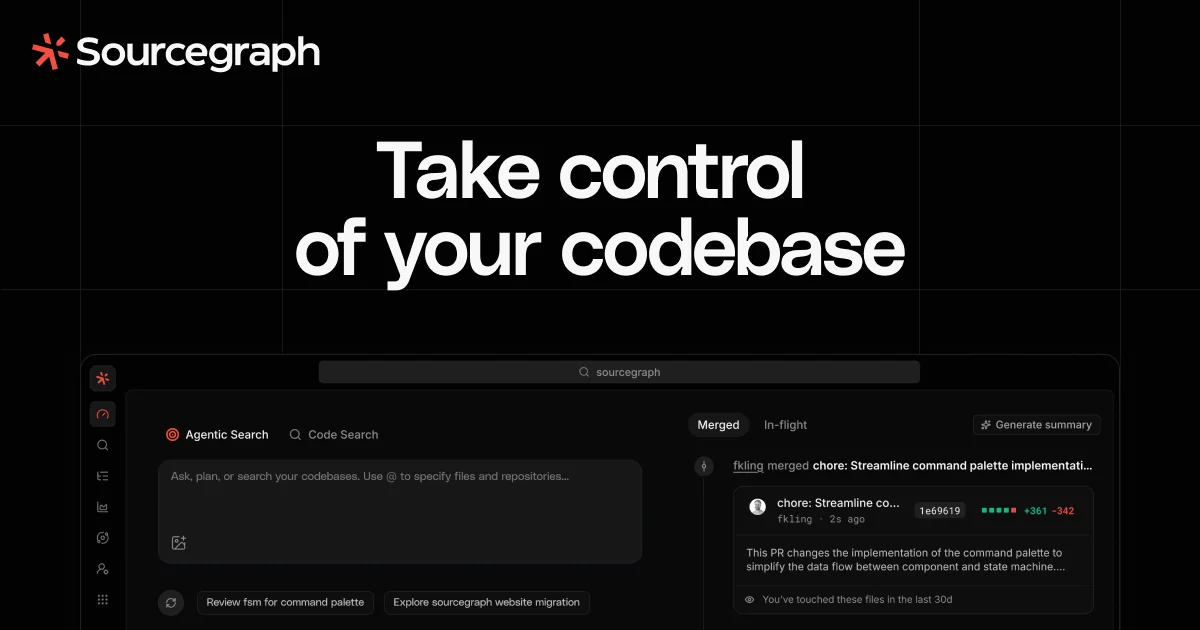
Large engineering organizations rarely stall because one file is hard to edit; they stall because nobody can see how a single change ripples across thousands of repositories. Sourcegraph attacks that gap by indexing an entire codebase and exposing that index two ways: to humans through search, and to AI coding agents through a Model Context Protocol server. The Sourcegraph homepage frames the pitch as "Take control of your codebase" and splits the platform into three jobs the vendor labels understand, oversee, and evolve.
The understanding layer of Sourcegraph rests on Code Search, which Sourcegraph describes as exact, deterministic, and exhaustive across an entire codebase, and on Deep Search, where a person asks a complex question in natural language and Sourcegraph returns grounded answers with citations. The example questions Sourcegraph publishes come from a security engineer, a software engineer, a designer, and an account executive, which signals that Sourcegraph is positioned as a company-wide code knowledge surface rather than a search box only backend teams touch.
The agent story is the newest emphasis in Sourcegraph. The Sourcegraph MCP server hands coding agents SCIP-powered context so an agent can run a keyword search across thousands of repositories before editing anything, which Sourcegraph says yields reliable results with fewer retries and lower inference spend. Sourcegraph illustrates the contrast with a worked example: an unassisted agent adds a Role field to a Go struct and misses auth middleware, the API response DTO, audit logging, admin route guards, the invite flow, and integration tests, while the Sourcegraph-connected agent surfaces 31 files across 2,847 repositories and produces an eight-step plan. Sourcegraph also quotes Stripe, whose internal "Minions" agents gather code intelligence through Sourcegraph search over MCP.
Oversight in Sourcegraph comes from three named capabilities. Code Insights tracks migrations, adoption, and risk across the codebase over time. Code Monitoring alerts both teams and agents when code changes. Living Documentation is described by Sourcegraph as a continuously updated knowledge base of the codebase. For execution, Agentic Batch Changes is the Sourcegraph AI agent for large-scale edits aimed at onboarding, modernization, code health, and security remediation across every repository.
A typical week with Sourcegraph starts in search or Deep Search to scope a change, moves to Code Insights to see where a deprecated pattern still lives, runs a batch change to apply the fix fleet-wide, and leaves a code monitor behind so the pattern does not creep back in. Developers who prefer to stay in an editor pull Sourcegraph context into their IDE or into whichever MCP-capable agent they already run, which is the path Sourcegraph pushes rather than asking teams to abandon an existing copilot.
Packaging is the least transparent part of Sourcegraph. No public pricing page was reachable at the time of this review, the homepage offers only "Get demo" with no self-serve signup, and no $0 plan is published. Buyers should expect a quoted agreement negotiated through an Order Form, since the Sourcegraph Terms of Service references Order Forms, Professional Services Terms, and supplemental AI Terms of Use that apply to agreements entered before AI Tools arrived in the Services on February 15, 2024.
The limits follow from that model. Sourcegraph targets organizations with genuine Big Code problems, citing 200+ enterprise engineering teams, SOC2 Type II and ISO27001 compliance, zero data retention on LLM inference, SSO through SAML, OpenID Connect and OAuth, SCIM provisioning, and RBAC. A five-engineer startup gets little from that machinery and cannot buy a seat without a sales conversation. One vendor-published Deep Search question even asks whether searches can be limited or allocated per individual or team, which hints that usage governance for Deep Search is a live topic rather than a settled published quota.
Against peers, Sourcegraph occupies a different slot than an autocomplete copilot or an AI-native editor. GitHub Copilot, Cursor, and Windsurf compete on the keystroke; Sourcegraph competes on retrieval breadth and change governance, then feeds whatever agent a team already runs. Buyers weighing Sourcegraph are usually deciding whether cross-repository context and fleet-wide migration tooling justify an enterprise contract on top of the per-seat coding assistant already in place.