What is Origami?
Airsplash Inc., a Delaware corporation doing business as Origami, runs Origami as an agent-driven go-to-market workspace where a chat prompt replaces boolean filters and spreadsheet formulas.

Origami turns a plain-English description of an ideal customer into a verified prospect list, with AI agents searching 50+ live sources such as Google Maps, job boards and social profiles rather than a static database. Founders, agencies and sales teams pick Origami because LinkedIn and email sequencing ships free on every paid plan.
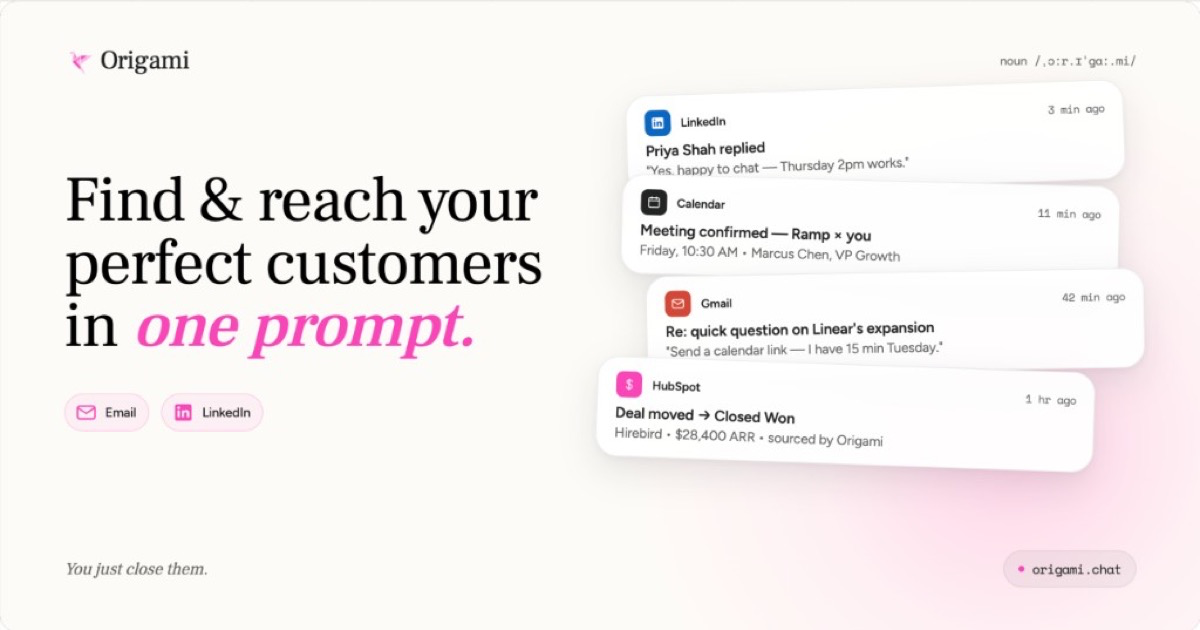
Verified facts from the vendor site · Last verified Aug 22, 2026. Independent Origami review covering pricing, features, who it is for, and alternatives.
Airsplash Inc., a Delaware corporation doing business as Origami, runs Origami as an agent-driven go-to-market workspace where a chat prompt replaces boolean filters and spreadsheet formulas.
Origami is freemium. It starts at $0/month. Paid plans include Free: monthly $0/mo: $0; Starter: monthly $29/mo: $29; Pro: monthly $129/mo: $129; Scale: monthly $499/mo: $499. Check origami.chat for current prices.
Origami has a free tier. Paid plans start at $29/month.
Origami is best for teams building lists of local operators such as HVAC, plumbing and roofing companies filtered by Google rating and review count and finding SMBs and contractors that traditional B2B databases under-index.
Origami is best for teams building lists of local operators such as HVAC, plumbing and roofing companies filtered by Google rating and review count and finding SMBs and contractors that traditional B2B databases under-index. Skip it if origami plan limits come from the published pricing table..
The main Origami features are Natural-language prospecting through a chat agent instead of boolean filters, Agents search 50+ live sources including Google Maps, job boards, licensing boards and the open web, Spreadsheet-style tables with per-cell enrichment runs, Email waterfall across 5 providers: Findymail, LeadMagic, Wiza, People Data Labs, Prospeo, and Phone waterfall across 9 providers including Bytemine, Forager, ContactOut and Zeliq.
The closest Origami alternatives on Citeware are Breakcold, Outreach, Seamless.AI, Saleshandy. Full list: https://citeware.io/alternatives/origami.
Limitations called out on this listing: Origami plan limits come from the published pricing table.; Origami packaging is recorded from the vendor pages available at analysis time..
Origami is available on Web.
vs Origami vs BreakcoldThe AI-native CRM for salespeople and AI agentsvs
 Origami vs OutreachAgentic AI platform for revenue teams to prospect, manage deals, coach, and forecastvs
 Origami vs Seamless.AIReal-time B2B contact search, outreach, and AI sales agents in one revenue enginevs
 Origami vs SaleshandyMultichannel outbound platform combining a B2B contact database, cold email sequences, a dialer, and deliverability tooling
Public threads about Origami
Community observations
No recent Hacker News threads
Nothing matched Origami on Hacker News right now. Search X, Reddit, or another network above.
Citeware analysis
Airsplash Inc., a Delaware corporation doing business as Origami, runs Origami as an agent-driven go-to-market workspace where a chat prompt replaces boolean filters and spreadsheet formulas. Rather than querying a licensed contact file, Origami dispatches agents against live sources at run time: Google Maps listings, 69M+ social company profiles, 350M+ people profiles, 100+ job boards, state licensing boards, funding news, review platforms and open-web pages. The Origami llms.txt states the outcome plainly — if a business exists online but is missing from Apollo or ZoomInfo, Origami can still surface the record.
The primary buyer for Origami is a founder or early go-to-market team, with enterprise plans layered on top for larger organizations. Origami leans into categories that classic B2B databases under-index, including contractors, clinics, local service operators and Shopify or WooCommerce merchants filtered by product, estimated traffic and detected technology. Agencies fit the Origami model too, because every paid Origami plan includes unlimited team members with no per-seat charge and separate workspaces for separate clients.
Day-to-day work in Origami happens in a spreadsheet-style table attached to a chat agent. A user types a target such as HVAC companies in Phoenix with 4+ stars and 50+ Google reviews, then Origami researches across sources, cross-checks results and fills rows. Contact data inside Origami runs through waterfalls: five email providers (Findymail, LeadMagic, Wiza, People Data Labs, Prospeo) and nine phone providers, where the first verified result wins and unvalidated addresses are withheld. From the same Origami table a user can draft cold email and LinkedIn copy, enroll prospects in the built-in Sequencer, push records to HubSpot or Salesforce, or export CSV.
The Sequencer is the packaging decision that separates Origami from pure list-building products. Origami includes email and LinkedIn cadences of up to ten steps per channel, unlimited sends from connected mailboxes and social accounts, multi-account rotation, time-zone aware delivery and one shared reply inbox on every paid plan with no add-on subscription. Origami also offers done-for-you provisioning of sending domains and inboxes, which the Origami Terms describe as separately billed subscriptions carrying per-inbox and per-domain fees.
Pricing published on the Origami pricing page starts at a $0 Free plan with 1,000 one-time credits, 20 agent messages and 30 rows per table, then Starter at $29/month for 2,000 credits, Pro at $129/month for 9,000 credits with the Origami 1.2 Max model, and a $499/month high-volume plan carrying 40,000 credits and a dedicated Slack channel. Enterprise pricing for Origami is quoted directly and adds SSO, SCIM, a custom SLA and unlimited concurrent workspaces. Credits in Origami are spent only on data work such as new leads, verified emails and phones, and enrichments, while talking to the Origami agent, transforming uploaded data and exporting are described as free; verified contact lookups are passed through at cost, published as $3 per verified email and $15 per verified phone, with no charge when no provider returns a match.
Buyers should read the Origami fine print carefully because the published pages disagree in places. The Origami homepage pricing block lists only Free, Starter and Enterprise, while the dedicated Origami pricing page lists five plans including Pro and the $499 tier. That $499 plan is labelled Scale on the Origami pricing page but Max in the Origami structured data and llms.txt, and the Origami Terms reference Starter, Pro, Scale, Ultra and Enterprise tiers. The Origami Terms and Privacy Policy also state that unused credits expire — generally after roughly three billing cycles on active paid plans and a rolling 60-day window on free or lapsed accounts — and that fees and credit purchases are non-refundable.
Compared with category peers, Origami positions against Clay on setup effort, against Apollo and ZoomInfo on freshness and SMB coverage, and against Instantly, Smartlead or Outreach on sequencing cost, since the Origami pricing page contrasts $50 to $250 per seat per month in the market with a Sequencer priced at $0 on any paid Origami plan. The trade-off is that Origami is credit-metered rather than seat-metered, so heavy enrichment volume, not headcount, drives the Origami bill. Native CRM depth in Origami is also narrower than legacy suites: HubSpot and Salesforce receive one-click pushes, and everything else in Origami routes through CSV, the API or webhooks.
Suitable for
Teams building lists of local operators such as HVAC, plumbing and roofing companies filtered by Google rating and review count and finding SMBs and contractors that traditional B2B databases under-index
Evidence: Homepage (Primary) · Pricing (Primary) · About (Primary) · Verified Aug 22, 2026.
Citeware analysis
Evidence: Homepage (Primary) · Verified Aug 22, 2026.
Verified facts
Evidence: Homepage (Primary) · Verified Aug 22, 2026.
Verified facts
Free
$0/mo
Starter
$29/mo
Pro
$129/mo
Scale
$499/mo
Evidence: Homepage (Primary) · Pricing (Primary) · Verified Aug 22, 2026.
Verified facts
The company behind Origami is Airsplash Inc.
AI-powered go-to-market platform to discover, enrich, qualify and reach out to prospects. Conversational Chat Agent (Origami 1.2 Lite and 1.2 Max models) and automated agent runs. Reserves the right to modify, add to or discontinue the Service at any time. Origami also lists other losses and interruptions it does not cover.
Origami says it collects account and identity, contact details, payment information, product usage and analytics, and device and ip data. That data is used for authenticate you and manage Organization membership and access. The policy says Origami is not collecting used to train ai models.
AI-powered go-to-market platform to discover, enrich, qualify and reach out to prospects. Conversational Chat Agent (Origami 1.2 Lite and 1.2 Max models) and automated agent runs. Reserves the right to modify, add to or discontinue the Service at any time. Origami also lists other losses and interruptions it does not cover.
Origami says it collects account and identity, contact details, payment information, product usage and analytics, and device and ip data. That data is used for authenticate you and manage Organization membership and access. The policy says Origami is not collecting used to train ai models.
Account and identity
CollectingAuthenticate you and manage Organization membership and access
Contact details
CollectingProvide customer support and send service, transactional, and marketing communications
Payment information
CollectingProcess payments, manage subscriptions and credits, and prevent fraud
Product usage and analytics
CollectingAnalyze usage to understand, improve, troubleshoot, and develop the Service
Device and IP data
CollectingOperate, secure, and debug the Service (diagnostic information, logs and telemetry)
User content and uploads
CollectingExecute the actions you invoke, including running enrichment and AI tasks and outreach
Cookies and tracking
CollectingAuthentication/session, analytics and session replay, and marketing attribution
Location
CollectingIP address and approximate location derived from it, collected automatically to operate and secure the Service
Shared with third parties
CollectingRetrieving and enriching prospect data from third-party data providers and public sources at your direction
Advertising and remarketing
CollectingMeasure and attribute marketing and advertising (hashed email for ad matching)
Used to train AI models
Not collectingPrompts and Customer Data transmitted to model providers solely to generate the outputs you request; providers process only to provide the Service
How long data is kept
UnclearAttribution cookie stored up to approximately 400 days; audio not retained after transcription
Evidence: Terms (Primary) · Privacy (Primary) · Verified Aug 22, 2026.
Citeware analysis
Named models, written separately. These are labeled Citeware analysis, not vendor claims.
anthropic · claude-opus-5 · Aug 22, 2026
Origami is a credible live-web prospecting agent for the long tail of local operators and SMBs that static databases under-index, and bundling sequencing with unlimited seats makes the entry price unusually honest. The catch is that credits, not seats, are where the real bill shows up.
August 2026: the seat-free pricing is real, but the meter is not. Judge Origami on credit burn per verified contact, not on the $29 sticker.
The bet here is sound. If your ICP is a roofing company with 4+ stars or a Shopify merchant running a specific stack, live sourcing across Google Maps, licensing boards and job boards beats querying a database that was refreshed last quarter.
For well-covered enterprise tech buyers, that advantage mostly evaporates and you are paying for research you could get elsewhere.
Strengths
Watch-outs
openai · gpt-5.6-terra · Aug 22, 2026
Origami is a compelling outbound workspace for finding hard-to-index local and SMB prospects, then acting on them without assembling a separate enrichment and sequencing stack. Its agent-first simplicity is attractive, but credit economics and sending-account terms deserve close scrutiny before scaling.
As of August 2026, Origami stands out where live-web coverage matters more than a polished, static B2B database.
Origami’s strongest argument is practical: it can turn a plain-English request into prospects drawn from live web sources, which is unusually useful for contractors, local operators and niche merchants. The table-to-enrichment-to-outreach flow should reduce tool sprawl for lean GTM motions.
Strengths
Watch-outs
Verified facts
Common questions about Origami.
Airsplash Inc., a Delaware corporation doing business as Origami, runs Origami as an agent-driven go-to-market workspace where a chat prompt replaces boolean filters and spreadsheet formulas. Source: https://origami.chat/
Origami is freemium. It starts at $0/month. Paid plans include Free: monthly $0/mo: $0; Starter: monthly $29/mo: $29; Pro: monthly $129/mo: $129; Scale: monthly $499/mo: $499. Check origami.chat for current prices. Source: https://origami.chat/pricing
Origami has a free tier. Paid plans start at $29/month. Source: https://origami.chat/pricing
Origami is best for teams building lists of local operators such as HVAC, plumbing and roofing companies filtered by Google rating and review count and finding SMBs and contractors that traditional B2B databases under-index. Source: https://origami.chat/
Origami is best for teams building lists of local operators such as HVAC, plumbing and roofing companies filtered by Google rating and review count and finding SMBs and contractors that traditional B2B databases under-index. Skip it if origami plan limits come from the published pricing table.. Source: https://origami.chat/
The main Origami features are Natural-language prospecting through a chat agent instead of boolean filters, Agents search 50+ live sources including Google Maps, job boards, licensing boards and the open web, Spreadsheet-style tables with per-cell enrichment runs, Email waterfall across 5 providers: Findymail, LeadMagic, Wiza, People Data Labs, Prospeo, and Phone waterfall across 9 providers including Bytemine, Forager, ContactOut and Zeliq. Source: https://origami.chat/
The closest Origami alternatives on Citeware are Breakcold, Outreach, Seamless.AI, Saleshandy. Full list: https://citeware.io/alternatives/origami. Source: https://origami.chat/
Limitations called out on this listing: Origami plan limits come from the published pricing table.; Origami packaging is recorded from the vendor pages available at analysis time.. Source: https://origami.chat/
Origami is available on Web. Source: https://origami.chat/
Common Origami use cases include Building lists of local operators such as HVAC, plumbing and roofing companies filtered by Google rating and review count, Finding SMBs and contractors that traditional B2B databases under-index, Enriching an uploaded CSV of past customers and generating lookalike prospect lists, Monitoring funding rounds, job postings and executive changes as outbound triggers, Sourcing Shopify and WooCommerce merchants by detected technology and traffic estimate, Drafting and running multi-step LinkedIn plus email cadences from the same table as the list, Pushing qualified, verified records into HubSpot or Salesforce without CSV round-trips, Standing up an agency's client-by-client outbound in separate workspaces without per-seat costs. Source: https://origami.chat/
Origami is made by Airsplash Inc, founded in 2024. Official site: https://origami.chat/. Source: https://origami.chat/company
Origami collects account and identity. Authenticate you and manage Organization membership and access. Origami collects contact details. Provide customer support and send service, transactional, and marketing communications. Origami collects payment information. Process payments, manage subscriptions and credits, and prevent fraud. Origami collects product usage and analytics. Analyze usage to understand, improve, troubleshoot, and develop the Service. Origami collects device and ip data. Operate, secure, and debug the Service (diagnostic information, logs and telemetry). Origami collects user content and uploads. Execute the actions you invoke, including running enrichment and AI tasks and outreach. Origami collects cookies and tracking. Authentication/session, analytics and session replay, and marketing attribution. Origami collects location. IP address and approximate location derived from it, collected automatically to operate and secure the Service. Origami collects shared with third parties. Retrieving and enriching prospect data from third-party data providers and public sources at your direction. Origami collects advertising and remarketing. Measure and attribute marketing and advertising (hashed email for ad matching). Origami says it does not collect used to train ai models. Prompts and Customer Data transmitted to model providers solely to generate the outputs you request; providers process only to provide the Service. Origami does not clearly say whether it collects how long data is kept. Attribution cookie stored up to approximately 400 days; audio not retained after transcription. Source: https://origami.chat/privacy-policy
Confirm pricing, limits, and support on the official site before you buy. Source: https://origami.chat/
Evidence: Homepage (Primary) · Verified Aug 22, 2026.
Looking for more options? Browse all Origami alternatives.
Public threads about Origami
Community observations